
A Fact-Check for the Four-Color World

Thursday, October 18, 2007

Isn't this just nitpicking?

A few readers have at various times remarked upon the necessity or desirability of this blog, suggesting that it's nitpicking, or somehow rude to the artists whose work we critique, or reveals a negative attitude toward the comics in question.

So I'll take another whack at explaining it, only this time I think I'll let an expert do the heavy lifting. Here's Matthew J. Bruccoli, editor of the Cambridge University edition of F. Scott Fitzgerald's The Great Gatsby. Dr. Bruccoli is a Distinguished Professor Emeritus of literature at University of South Carolina and a leading authority on Fitzgerald. On the subject of accuracy, Dr. Bruccoli says, "Factual errors in fiction distract readers who spot them and may undermine confidence in the work and the author.* Many careful readers hold that if an author cannot be trusted in details, he may not be trustworthy in larger matters."

Dr. Bruccoli goes on to explain the two types of errors that occur in fiction, external errors (those regarding the actual world in which the work is set) and internal errors (those involving the fictional world).

Returning to the world of comics, we can call continuity problems "internal errors", and this blog is utterly unconcerned with them. If a given issue of Superman says that Clark Kent's middle name is "Joseph" and another says it's "Jerome", that's an internal error, and fans are welcome to argue over it to their heart's delight (or they can declare that his full name is "Clark Joseph Jerome Kent", as Wikipedia says).

We are concerned here with external errors, that is, things in the actual world that comics get wrong for no good reason. When Loren takes on issues of law here, he seldom deals with the fictional laws presented in comics except as how they interact with real-world laws that are assumed to be in force in the comics world. The primary concern is how real-world law is presented in cases where no comics-world law is in play, as for example in issues of courtroom procedure.

Or as I said from the beginning, I'll accept that Green Arrow can shoot an arrow through an ant's ass at 100 yards while swinging upside-down from a chandelier... provided you first show me that he knows how to hold a bow.

One comic writer, discussing a character's amateurish shooting form, told me that "the guy is just that good, he can still be accurate even shooting that way. He's doing it on purpose." Sorry, that doesn't wash. The laws of physics may not apply to Superman lifting a building, but they do apply to Hawkeye aiming an arrow, otherwise there's no point in having an archery-themed superhero at all. At that point it merely becomes a fashion choice, a theme, and not an ability at all.

Similarly, inconsistencies in the geography of Metropolis are not our concern, but inconsistencies in the geography of real-world places like New York, such as moving the Empire State Building, are an issue for us. I hope you see the difference.

* Bruccoli, "Getting it Right: The Publishing Process and the Correction of Factual Errors--With Reference to The Great Gatsby," Library Chronicle of the University of Texas at Austin, 21, no. 3-4 (1991), 41-60. Quoted in Fitzgerald, F. Scott, The Great Gatsby, The Authorized Text, Scribner Paperback edition (2003), p. 192.

Labels: ,

Tuesday, October 16, 2007

Artistic license?

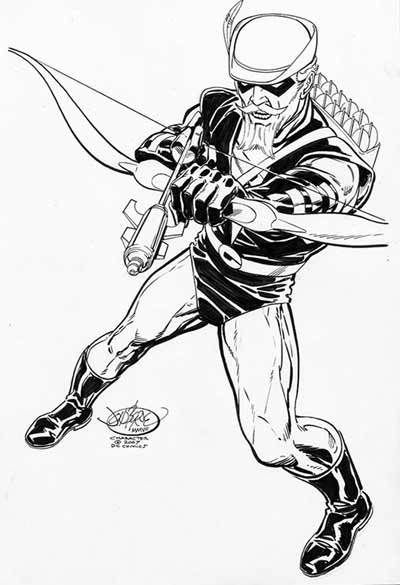
Over at John Byrne's forum, a reader from Hong Kong asks "Mister B., do the pose of the character is an accurate pose of using bow and arrow, or is it involving artistic licence for the sake of a good pose ?"

Byrne replies "Artistic license."

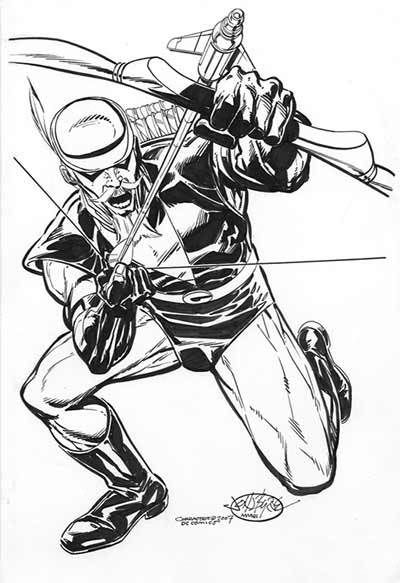
Sorry, Mr. B, but that dog won't hunt. Artistic license is valid for picture #2, since it's clearly a frozen moment in the action, so even though Ollie obviously doesn't know how to shoot a bow, it can squeak by on the argument that he hasn't finished drawing.

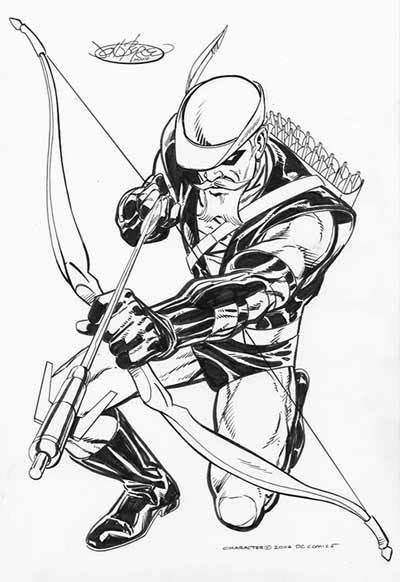
Number three might even be arguable, even though the arrow is falling off the bow.

But that first picture is just wrong. Incontrovertibly wrong. Try it yourself. Grab a yardstick and a piece of string, make a bow and try to draw it that way, pulling the string up over your shoulder on the outside of your arm. It does not work, and calling it artistic license doesn't cover it because the pose is awkward and doesn't look good.

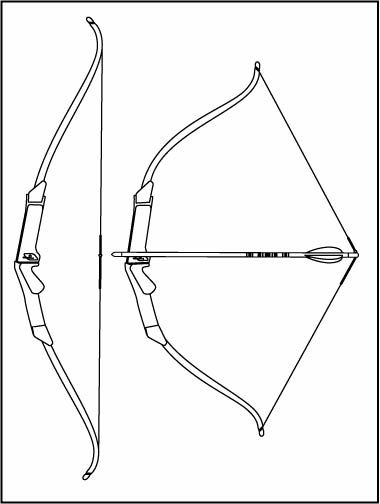
Here's what it should look like.

Labels: , ,

Monday, October 15, 2007

John Byrne goes 0 for 3

Over at John Byrne's forum (byrnerobotics.com), he recently posted some of his drawings of Green Arrow. Given that Mr. Byrne is a notorious stickler for accuracy (see any of the numerous controversies in which he's embroiled himself, such as the logical inconsistencies of Captain Carrot), let's see how he does with archery...


Photo Sharing and Video Hosting at Photobucket


Photo Sharing and Video Hosting at Photobucket


Photo Sharing and Video Hosting at Photobucket


First, the positives: Byrne's Green Arrow is consistently right-handed, consistently has the arrow on the correct side of the bow, and consistently has the fingers on the string in the correct orientation. His bow fairly accurately resembles an old-fashioned Ben Pearson or Fred Bear one-piece recurve in most respects.

On the minus side, there's no way that this guy can shoot straight. No anchor. No back tension. He's canting the bow. Arrows only have two fletches, or are nocked upside-down so that the index fletch will strike the riser. In picture #2, GA is pulling on the shaft rather than the string. In #3, the arrow has fallen off the bow and is resting on GA's knuckles.

Worse, in picture #1, Green Arrow is drawing the bow up above his bow arm. The string should be under the arm. Of course, the bow should be vertical, but apparently archery has been affected by the same idiocy that causes gangbangers to turn their guns sideways in order to try to look "cool".

I don't know what those little cuffs on the ends of the limbs are supposed to be, but that's not how the string attaches to the bow.

In a nutshell, if this guy showed up at my range, I'd send him back to the beginner class.

Mr. Byrne, my offer still stands. If you would like assistance in portraying archery accurately, I am happy to offer photos, consultation and reference materials free of charge. If you happen to be in the Los Angeles area at any time and would like to try archery for yourself, I am happy to offer free lessons, including the use of all equipment, at any convenient time.

Labels: ,

Wednesday, January 31, 2007

You'd think network execs would know this stuff....

Studio 60
A group of network honchos are discussing a possible new "reality" show with a romance theme, which they have titled "All You Need is Love". The following dialogue follows:

Hallie: We can't get the rights to the title "All You Need is Love"...

Jordan: The Beatles said no?

Hallie: There was already a show that used it.

Jordan: Damn it to hell!

Anyone with even the slightest knowledge of intellectual property law (even a layman like myself) would have known that there were no "rights" to get. Copyright law does not protect titles, short phrases, or words, and unless the Beatles or the producers of the prior show had filed for trademark protection and still have an active interest in the name, the name is freely available. The case can also be made that "all you need is love" is a common phrase known to be in use long before either the song or the show in question.

There have been many shows, plays, books, movies and songs that use the same title, and it is perfectly legal and proper to do so. A search of the IMDB will turn up many such examples...

Saving Grace (movies in 1985, 1998, 2000, and a 2006 song by Tom Petty)
Crash (films in 1922, 1977, 1987, 1996, 2004, and several TV shows)
Bombshell (1933, 1935, 1996, 2006)
... and so on.

In addition, there are a lot of films with titles based on songs, including:

Blue Velvet
And the Band Played on
Boogie nights
Man on the Moon
Can't Buy Me Love
Sixteen Candles
Uptown Girls
My Own Private Idaho
American Pie
Happy Feet
Pretty Woman
Some Kind of Wonderful
Beyond the Sea
Down with Love
When a Man Loves a Woman
My Blue Heaven
Sweet Home Alabama

...and so on.

There is absolutely nothing to prevent Hallie's show from going forward, except maybe the boundaries of good taste.

Labels: , ,

Thursday, October 26, 2006

Oh, Really?

Smallville: Arrow
So Smallville is doing Green Arrow, and now Chris Arndt, over in the comments on the last post, is eager to hear me rant about it.

Your wish is my command.

I haven't been watching Smallville much for about the past year; it got kind of tedious for me when they went off into all that kryptonian mumbo-jumbo with Jane Seymour and french witches and Brainiac the T-1000. But of course I heard that Green Arrow was coming, and so I set the Tivo. So here we are.

It sure is easy to be an impressive archer when your arrows are computer-generated. And apparently it's even easier if your bow is equally computer-generated. So let's see, what sins against archery are committed here? (I mean apart from the insult to Lois' intelligence; she can't figure out that the archery-themed bandit might have something to do with the new boyfriend who dresses up as Robin Hood?)

The telescopic-night-vision targeting sunglasses. What's wrong with letting him just be that good? He's supposed to be a superhero; maybe it would help if he were a little bit, well, super.

The semi-automatic crossbow. With a retracting cable, no less. I'm still trying to figure out how that thing reloads and draws itself. But that pales beside...

The self-folding compound bow. They made a point of only showing this gadget in the dark and on the move, so you never really got a good look at it, but no matter how much they tried to hide it, they have a few serious problems:

1. The limbs fold down. That is, they fold in the direction that the string would normally pull them. This means the bow can't function. The force of shooting the bow would surely damage or overcome whatever locking mechanism holds the limbs up until they're released. The bow should collapse in Ollie's hands when he draws it. If the producers wanted to be marginally believable, they should have had the limbs collapse forward over the handle, away from the string.

2. Where'd the string go? Ever get a good look at a compound bow? The string is this really elaborate affair that winds back and forth over cams and pulleys. There's no way to remove it without a very large, very heavy piece of equipment called a bow press. Somehow, at the click of a button, the string on Ollie's bow vanishes.

3. The wheels. At one point, Ollie uses his folded-up bow to ride down a line, riding on the bow's wheels which he's placed on the cable. Problem: One of the "wheels" is not a wheel at all. It's an elliptical cam, and it only turns about 3/4 of a revolution.

On the positive side, the taser arrow and the gas arrow were both pretty cool and pretty plausible. And the guy doing the shooting seems to actually know something, at least as far as compound shooting with a mechanical release is concerned. I didn't get a good look at his form with a recurve when he shot the pull-tab off the soda can last week, but what I saw looked reasonably decent.

On the other hand, the writing was atrocious.

I'm a graphic designer by trade. I've spent 40 hours a week for the last 16 years staring into a monitor. I breathe Photoshop. Exactly what software is Chloe using that can enhance and refine images the way she does in the last episode? She works at the Daily Planet, not NASA.

Labels: ,

Thursday, August 24, 2006

Almost Archery!

Earth's Mightiest Heroes 2

Photobucket - Video and Image Hosting

Wow, the Earth's Mightiest Heroes 2 cover almost looks like archery! He's got the arrow on the right side of the bow, he's actually using his back muscles instead of his forearm, and he's almost got an anchor point. The arrow is nocked backwards, but I've seen worse shooting than this at the range.

Now, can we please see about maybe learning what a bow looks like? The arrow goes on a rest or shelf, not on the knuckles.

*sigh*

Labels: ,

Monday, August 21, 2006

The New Justice League roster

Photobucket - Video and Image Hosting

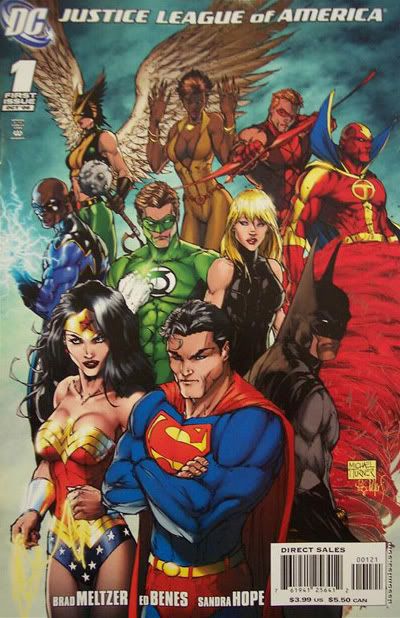
So when did Arsenal become left-handed? And why is he going to shoot Green Lantern in the head?

That's all. Carry on.

Labels: ,

Friday, June 16, 2006

Apology and retraction

I know this sort of thing seldom happens in the blogosphere, but that's why I publish under my real name. I have to take the hit when I'm full of it.

I was full of it recently when I complained about the regional dialects in "American Way." According to people who read this thing and actually live in the areas involved, the slang used in the story is accurate if a bit obscure.

Apologies to John Ridley.

Labels: ,

Monday, June 05, 2006

American Way #4: regional dialects?

I've been enjoying the Wildstorm miniseries "The American Way" despite occasional lapses in its portrayal of US history and culture. With the latest issue, it became painfully obvious that the writer is not an american.

We get as far as page two before the point is hammered home by Attorney General Robert Kennedy declaring "this is one hell of a cock-up, letting the world know this New American is a negro." (The story takes place during the Civil Rights movement of the early 1960s; "The New American" is a faux-superhero, part of a team created by the government as part of a national morale-building effort during the Cold War.)

I don't know anything at all about John Ridley, the writer of this series, but after reading this issue, I'll bet good money that he's british, based solely on his use (and misuse) of slang. Habitually, he has characters use words and phrases that I have only heard used by people from Great Britain, such as the aforementioned "cock-up".

Other examples:
On page 5, Lucky refers to "our east-coast minders." An american would have called them his "handlers."

On the same page, Southern Cross says "Bad enough you shine us into thinking...." I've searched a few online slang dictionaries, as well as Dictionary.com, but I can't find any definition of "shine" that fits the context in which it's used here. If this is in fact a southern US term, I've never heard it before. I welcome a correction or clarification.

On page 7, Freya says "The path to bettering Pharos doesn't travel through me." In this case, the term "bettering is used to mean "getting the better of." In american usage, "bettering" would mean "to improve." Granted, Freya is allegedly a Norse goddess, but it's clear she learned to speak english in Europe.

Aside from the misuse of slang, there is the matter of sentence structure and rhythm. Every character in the book speaks like a brit, even the ones with allegedly southern accents.

I found the dialect errors in this issue jarring enough to mar my enjoyment of the story. Fortunately there was a really brutal and violent conclusion to the comic which effectively engaged my lowbrow american sensibilities and allowed me to forget about the language thing. Here's hoping the next issue does a better job of making the characters sound like they actually live in the country they are portrayed as being from.

As Henry Higgins said, "why can't the English speak english?"

Labels: ,

Friday, February 10, 2006

Now that's more like it!

Young Avengers #10

You know, if I were prone to egotism, I'd be trying to grab credit at this point. Though honestly, I doubt if Jim Cheung even knows this blog exists. But whatever, even if it isn't a result of my relentless whining here, it's nice to see the cover of the latest issue:

Image hosting by Photobucket

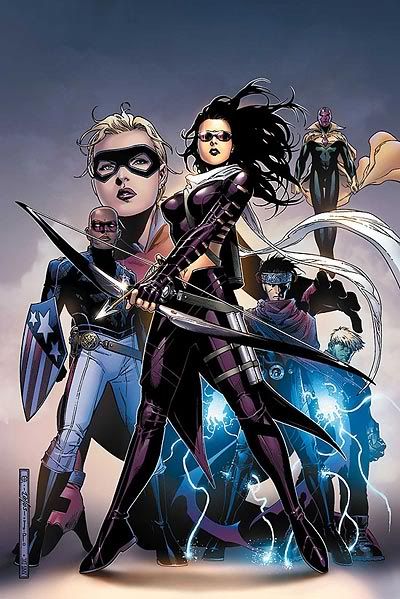
Well, well, well. What have we here? Kate's holding the bow correctly, the arrow is on the correct side of the bow, she's keeping her index finger the hell away from the arrow, her quiver is where it should be, and best of all, her bow actually looks like a bow. She's got a nice old-fashioned one-piece recurve there. It looks a bit like a vintage Fred Bear, though it might be one of those aluminum ones that were all the rage back in the early '70s. In any case, it's a real bow. Nice.

And the goodness continues inside. Young Avengers is comics done good. It's comics the way all comics should be; looking forward, not back. Taking elements from the past and building on them rather than rehashing, reinventing, recycling, reinterpreting, redacting, or rewriting them. It's comics that are smart, fun, exciting, compelling, engaging and (wait for it) entertaining. With characters you care about, behaving in character. If you aren't reading Young Avengers, you're missing out on what is quite frankly the best thing Marvel has been publishing in a while.

Okay, enough with the effusive fanboy praise. I like the book, we get it. But this is Suspension of Disbelief, the nitpick blog. So where are the nitpicks?

Okay, I'll give you one. And this one falls on Allan Heinberg, the writer, not the artist.

*ahem*

When the late Dr. Richard Feynman used to teach at Caltech, he occasionally performed the following demonstration, which will serve quite nicely to illustrate the nitpick at hand:

Dr. Feynman would reach into his coat pocket and pull out a rubber ball. He would bounce the ball on the desk. It would bounce a few times, then he would put his hand on it, pressing it to the desktop and arresting its movement. Then he would speak.

"I have damped the ball."

Dr. Feynman would then drop the ball into a glass of water. Then he would fish it out and set it, dripping on the desk.

"Now I have dampened the ball."

"Any questions?"

Comic book writers and editors: Please get this right. It's irritating when you don't. My comics are worth less when they have corrections written in with a red pen. Thank you.

Labels: , ,

Friday, December 16, 2005

What are they teaching in schools these days?

Truth to tell, I was supposed to write about Green Arrow's recent appearance in Birds of Prey, but there's really not much new to say about that one; the few errors that appear are mostly minor and are things I've already flogged to death in previous posts. Fortunately, Geoff Johns and Tony S. Daniel have stepped up to the plate and provided grist for the mill.

Teen Titans #30

First off, it's wonderful to see a new Captain Carrot story. If you agree, e-mail DC and tell them so. That way maybe they'll give us a new series. Wouldn't that be nice?

But I digress.

So anyway, the Titans are gathering for battle against Brother Blood and his undead minions. We finally get to the new Speedy, A.K.A. Mia...

Image hosted by Photobucket.com

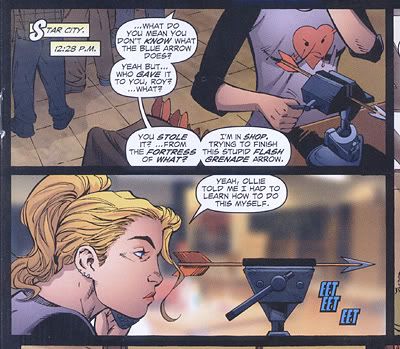
Mia, according to what she tells Roy, is in school, at shop class, working on a "stupid flash grenade arrow" in a vise grip. Okay, so let's leave aside for a moment the painfully obvious fact that in these paranoid and litigious times there is not a high school in America (in any universe, DC or otherwise) that is going to allow a minor to (a) make arrows on campus and (b) make explosive or incendiary arrows in class. No, sorry, it's not going to happen. This scenario is more unbelievable than any of the superpowered adventures in the rest of the book. Heck, the Captain Carrot sequences have more credibility than this scene. But, as I said, we'll leave that aside and get to the really egregious part.

The really egregious part being, one does not construct arrows in a heavy-duty woodworking vise. One would use a fletching jig. Here's a simple one from Cartel:


Secondly, the arrow Mia is shown working on is a good 10" too short for her. Based on her age, height and build, I would guess her draw length to be somewhere in the vicinity of 28", maybe even 29" if her form is perfect (it's not). The arrow she has clamped up there getting crushed and ruined in that clumsy iron monstrosity looks to be maybe 16-18" long at the outside.

If she tried to shoot that arrow, one of two things will happen:

1. She will draw the bow to 16" and release. Let's assume for the heck of it that she's using a 40 pound bow. There's a mathematical formula we can use: that 40 pounds is the draw weight when the bow is drawn to 29"; for each inch below that length, we subtract 2 pounds of power. 29" minus 16" leaves 13". 13 times two is 26. 40 minus 26 is 14. Mia will shoot that arrow with the equivalent of a 14 pound bow. With that big heavy payload, that arrow will hit the ground within about 30 yards. Hopefully that's far enough for her not to be injured by the flash grenade.

2. She will accidentally draw the bow too far back, the arrow will fall off the rest, and she will shoot herself right through her left hand. Ouch.

I know Ollie wants her to learn to do it herself, but does he really want her to learn the hard way?

Labels: ,

Wednesday, November 30, 2005

Oooh! That's Gonna Hurt!

She-Hulk #1

As promised, here's the final panel from the third-to-last page of She-Hulk #1.

Image hosted by Photobucket.com
I think by this point I don't even have to say anything about it. I'll just throw it open for comments and allow the readers to have at it. Anyone? Bueller?

Labels: ,

Friday, November 25, 2005

Curses! Foiled again!

Young Avengers #9

I have really been enjoying Young Avengers despite the downright silly archery portrayals; the character work is interesting, realistic and multi-layered, and on the whole the book is a great approach to the concept of a team of teen sidekicks for the Avengers, sort of a Marvel version of the Teen Titans. Great book, and one I highly recommend.

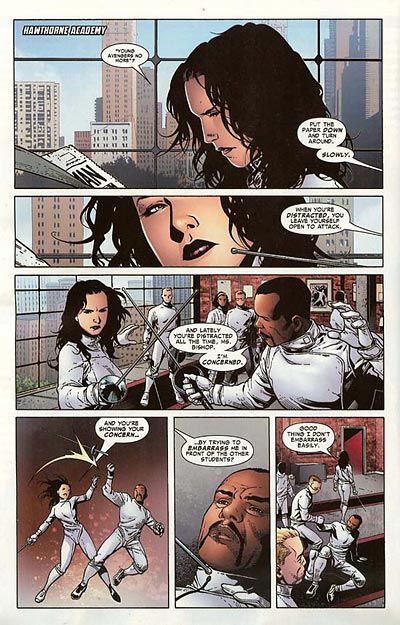
Just please don't follow any of their advice as involves what we call "martial sports," which is to say, sports derived from combat skills. In this instance, it's fencing, not archery.

Here's the page in question:
Image hosted by Photobucket.com

The dialogue probably isn't visible at this size, so here's a transcript:

PANEL 1
KATE: (reading paper) "Young Avengers no more"?
TEACHER: (offstage) Put the paper down and turn around. Slowly.

PANEL 2
TEACHER: (offstage) When you're distracted, you leave yourself open to attack.

PANEL 3
TEACHER: And lately you're distracted all the time, Ms. Bishop. I'm concerned.

PANEL 4
KATE: And you're showing your concern...

PANEL 5
KATE: ...by trying to embarrass me in front of the other students?

PANEL 6
KATE: Good thing I don't embarrass easily.

Okay, so now we're all on the same page. What's wrong with this scene?

First off, where are the fencing masks? No competent instructor would ever allow students to bout without masks, let alone engaging in such dangerous behavior himself.

Far more serious, however, is the entire portrayal of fencing in this scene. Fencing is a "martial sport" as I said earlier, but it is not in the same category as other martial arts; it is taught as a sport, not as a form of self-defense or combat. There are a lot of rules involved in fencing, and failure to follow them results in penalties and possible disqualification in a tournament setting. The instructor in this scene appears to be teaching swordsmanship as self-defense, which would appear to be a fairly useless skill unless one is planning to hang a rapier from one's hip while strolling down Eighth Avenue. I rather supsect New York's Finest would take a dim view of such shenanigans. With that in mind, why is our fencing master here prattling on about defense against attacks?

In fencing, one knows when one is about to be attacked; it is usually preceded by the combatants saluting one another on the strip. Beginning an attack without the requisite salute is a violation; it shows disrespect for the opponent, the judges and the sport.

Once a bout has begun, knocking one's opponent to the ground is also a violation. In fact, if a fencer disarms an opponent, the bout is stopped and the fencer usually picks up the opponent's weapon and returns it to him/her. Pressing the advantage and continuing the attack is, again, a rule violation.

The goal of fencing is to touch one's opponent with the tip of the foil (I assume these are meant to be foils based on the bell guards and body language; the weapons themselves are wildly inaccurate here). Pointing the foil at the opponent's throat is nice as dramatic gestures go, but it doesn't really accomplish anything, what with the rubber tip on the end and all.

So what we have here is a dangerously incompetent instructor given to dramatic posturing, and a dangerously irresponsible student disregarding all the rules of the sport in an instructional setting. I wonder which of the other students will report them both to the Headmaster.

Labels: ,

Sunday, October 23, 2005

Add to your swipe file

Attention, Hawkeye and Green Arrow artists: Go see the new Nicolas Cage film, The Weatherman and take notes. The movie may not be any good, but based on the publicity photos I've seen, the archery is at least right.


Take particular note of the bow. The riser (handle) part is about two feet tall, with a couple of inches between the hand and the arrow rest. Also take particular note of how the fingers hold the string, and which side of the bloody bow the arrow goes on. Also note where the hand and string touch the face. While you're at it, note the posture. This is what archery looks like. From the ribcage down, you can have him doing anything you want-- swinging from a trapeze, riding a unicycle, running at full-tilt-- but from there up, this is what it should look like.

If I were a betting man, I'd wager that Don Rabska was the archery coach on this film.

Labels: ,

Monday, October 17, 2005

Those Who Can't Do (Part II)

I got so caught up in addressing the technical errors and such in the last post that I completely overlooked the most fundamental of all....

Rule #1: Do not point an arrow at anything you do not fully intend to shoot.

In Panel 2, Hawkeye should have said "PUT THAT DOWN!"

He should have then followed with a stern lecture about safety. He most certainly should not have followed up with an imprompu lesson using the pilot's head as the target.

If they don't want the pilot dead, they should not be pointing arrows at him.

Labels: ,

Sunday, October 09, 2005

Those who can't do, teach.

Ultimate Secret #3
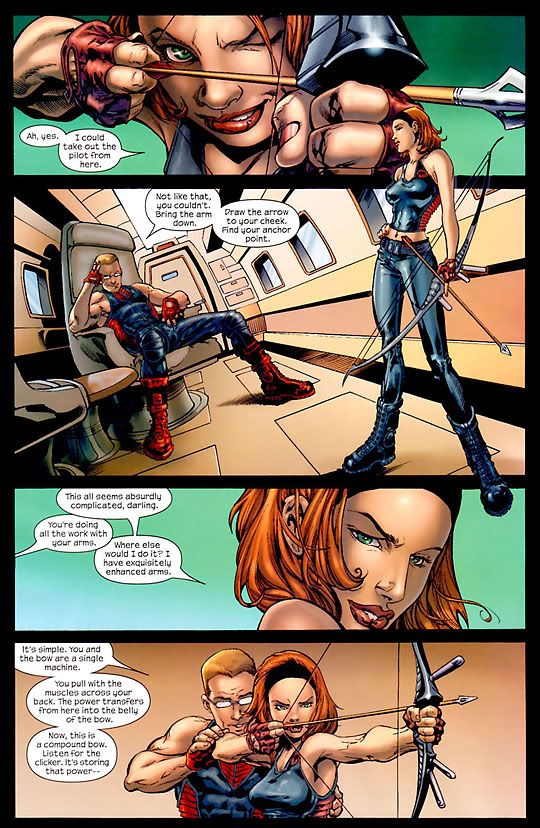
I don't follow the Ultimate line at all, so I have no idea who is supposed to be what, and in fact have not seen any of this issue except this one page that was e-mailed to me by Typo Lad of What WERE They Thinking? fame. So if I guess wrong at one of these character's identities or some such, well, that's to be expected.

Anyway, like I said, Typo sent me this page and asked for my comments....

Image hosted by Photobucket.com

There's just so much to say here....

In general, the writer has done a little bit of research, but the artist clearly hasn't.

Panel one: The bow has no arrow rest. Apparently the arrow sits on top of the archer's hand. Of course, here in the real world, you only find that in traditional (longbow).

Moving on, what's with the gloves? Those are biker's or weightlifter's gloves, designed to provide protection for the palms while leaving the fingers free. Archer's gloves are exactly the opposite, covering the fingertips and leaving the rest of the hand free. Fingerless gloves are worse than useless to an archer.

Panel two: the guy actually gives good advice in this panel, but my sense is that neither the writer or artist have any idea what they mean; they are just disjointed snippets of archery instruction devoid of any underlying rationale.

Panel three: The guy's comment is exactly right; most beginning archers do all the work with their arms, and it is the most serious form flaw.

Panel four: Here we get into trouble. Let me dissect the text here a bit at a time:

"It's simple. You and the bow are a single machine."
okay, that's just psychobabble that has nothing to do with anything. It's accurate enough, and something an instructor with zen pretensions might say, but it doesn't address the lady's problem.

"You pull with the muscles across your back."
So far, so good. What he's describing here is that the shoulderblades should push toward each other, it should feel as if you are doing a pushup.

"The power transfers from here into the belly of the bow."
say what? I've never heard anyone refer to "the belly of the bow"; this is the writer making up claptrap to cover the fact that he has no idea why one would draw a bow using the back muscles rather than the arms. More babble.

"Now, this is a compound bow."
Oh no it's not. That thing in no way resembles any compound bow ever made. It's some sort of mutant blend of a recurve's limbs, a longbow's grip, and an extra string stuck in there somehow. I don't know what the hell it is, frankly.

"Listen for the clicker."
uh oh. We have a problem. Compound bows don't use a clicker. They don't need one. A compound bow has a fixed draw length; you draw it back to a certain point and it stops. It "hits the wall" as they say. Recurve bows do not have a fixed draw length. The archer can draw the bow a different distance each time, which affects its accuracy. A clicker is a device that recurve shooters use to tell them when they are at full draw. As the arrow tip passes the clicker, it clicks, telling the archer that the bow is drawn to the distance it's supposed to be.

"It's storing that power--"
Again, say what? The clicker is storing the power? Oh no it's not. It can't. The bow has somewhere between 20 and 60 pounds of power stored up in it, and the clicker is a thin little piece of metal, either a strip of spring steel or a little rod and magnet arrangement; neither of them can store more than an ounce or so of power.

I'll repeat my offer; any comic writer or artist interested in getting archery right can call me, e-mail me or write me (I'm in the Pasadena Phone book), and I will happily assist you for free. If you happen to be in the Los Angeles area, I will happily give you free archery lessons.

Just please stop trying to make it up. You're giving me a headache.

Labels: ,

Saturday, October 01, 2005

Why doesn't Green Arrow ever do this?

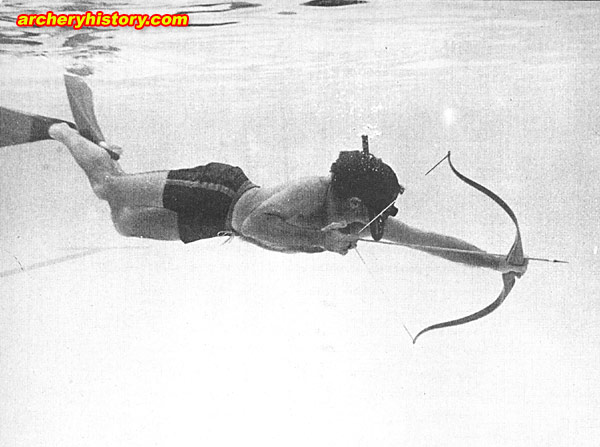
Or would it intrude on Aquaman's territory too much?

Labels: ,

Wednesday, August 17, 2005

Where Winick Lost Me

Green Arrow Secret Files & Origins

I've mentioned it a few times, but the time has come to explain why the lead story in this comic is so aggravating.

As the story opens, Ollie and Connor are practicing shooting at long distance targets, "placed about as far away as I could but still make them out with the naked eye," which leads into this conversation:

Connor: We should be using long bows for this.

Oliver: You carry a spare long bow around with you in the field?

Connor: I have a collapsible one, yes.

Oliver: Really? Blasphemy. You can't possibly get the same tension from your Swiss Army-knife toys than an actual bow.

Connor: Join me sometime in the 21st century. I'll show you some adaptations that would make your trick arrows look like buggy whips.


Stop. Rewind. Let's go through that again, with some editorializing from yours truly...

Connor: We should be using long bows for this.

Me: Really? Why? Do you think a "long bow" is called that because it's used for long shots? You should be using compound bows for this. Of course, at the distance suggested here, the targets should be lying flat on the ground, and you should be shooting way up in the air to create a parabolic arc. There's no other way to make that range.

Oliver: You carry a spare long bow around with you in the field?

Connor: I have a collapsible one, yes.


Me: Say what? Do you mean a takedown? Yes, there are two-piece takedown longbows, but most longbow shooters are pretty much purists; they want the one-piece, as Ollie says. And nobody calls them "collapsible" except people who are utterly ignorant of the sport. Oh. Wait.

Oliver: Really? Blasphemy. You can't possibly get the same tension from your Swiss Army-knife toys than an actual bow.

Me: Um, that sentence isn't even English. Aside from that, "tension"? What tension? Who talks about tension in archery? Ollie, have you ever shot a bow before?

Connor: Join me sometime in the 21st century. I'll show you some adaptations that would make your trick arrows look like buggy whips.

Me: "Adaptations"? Sounds like B.S. to me. You're just trying to pretend you know what you're talking about, aren't you?

And so on.

Next page, we're informed that the boys are shooting "the length of several football fields." Okay, sure. Olympians only shoot at 90 meters (about 100 yards), but we'll take them at their word... that is, until we get to the next page, where Connor can actually see a 3/8" thick arrow hit the approximately-5-foot-diameter target, when we were just told that they could barely make out the targets. I didn't know super-vision was among Connor's gifts. (Of course, if they had any supervision, they wouldn't be engaging in this silly game anyway... har!)

Eventually, the boys get to the point of the scene, which is a segue into yet another of Winick's tales about a demon attack, which amazingly enough, only has one really dumb archery moment. But before we get there, Connor allows as how he has "about a thousand arrows to get to here," so he has plenty of time to hear the tale.

Indeed he does. Any archer knows that fatigue sets in rapidly if shots are taken too close together. It takes about 20 seconds for the lactose buildup in the muscles to dissipate, so any smart archer will pace himself. In tournament settings, archers are permitted two minutes to shoot three arrows, but let's assume that Connor is used to shooting an arrow every 30 seconds (10 seconds to shoot, 20 seconds to recover before taking the next shot). So he's going to take 500 minutes at least to get through those arrows, or in other words, 8 hours and 20 minutes. I hope they packed lunch.

That doesn't include the time it will take to walk back and forth the several hundred yards (a mile is 1760 yards) to collect their arrows. Assuming that their quivers hold 50 arrows (a not unreasonable number, considering my quiver holds about 18 max). they're going to make that walk 20 times at least, round trip, for a grand total of about 10 miles. Walking at a brisk pace, they cover 3 miles an hour, so in addition to the 8:20 shooting time, add another 3:20 walking time, for a grand total of 11 hours and 40 minutes at the range. I hope they packed dinner.

But I digress.

So now Ollie is into his demon story, replete with all the usual silly archery mistakes (gravity-defying arrows that suspend themselves in the air without any support, arrows on the wrong side of the bow, balancing the arrow on the tip of the thumb, drawing the string up over and behind the ear, and so on), but the really egregious part is coming. Ollie has to make a shot at a really long distance over a ravine, and he strains to do it...

"God... I hope... I don't snap the bow... before I get the shot off... it's just... such... a long... one..."

Tell me, Ollie, have you ever shot a bow before?

A big part of aiming a bow is what they call "anchor." This means putting the hand against the face in a certain spot, the same way every time. this functions like the rear sight on a rifle. Without a consistent anchor, accuracy is impossible. When making a long shot, one does not draw the bow back further (which would be impossible anyway if he's shooting properly; the drawing is done with the back muscles and there's only so far they can move); one would switch to a lighter arrow or heavier bow, or one would simply aim higher and allow gravity and inertia to do the work.

So Ollie finishes his story, and the boys set off on their quarter-mile hike to collect their arrows... with full quivers on their backs. Dunno about you, but if I were going to shoot that far, I'd go ahead and empty the quiver before I went and collected the arrows. But that's just me. I guess they like long walks.

Or more likely, Judd Winick engages in hyperbole in order to hide the fact that he doesn't know the first thing about the central fact of his main character, and can't really be bothered to find out.

In any case, that's the last Green Arrow story I'll be reading until he's gone.

Labels: ,

Monday, August 15, 2005

Green Arrow's Specialty Arrows

Green Arrow Secret Files & Origins

Eliot R. Brown has established himself as the go-to guy for "realistic" (or at least plausible) diagrams and explanations of superhero equipment. Sadly, in his Green Arrow Secret Files & Origins piece, he really drops the ball.

Most of his diagrams look pretty good (except the bow, but we'll get to that), but it all falls apart in the text, mostly because he didn't do any research into archery terminology or techniques. Examples, beginning with the most trivial and proceeding to escalate in importance:

Thoughout the article, he refers to arrows being "notched." The word he's looking for is "nocked." Similarly, he consistently refers to bows being "pulled." Bows are not pulled, they are drawn. Archers speak of a bow's "draw weight;" they do not say things like "a custom pull of 125 pounds." Aside from the erroneous use of "pull" there is the question of what a "custom pull" might be. But that is the least of the problems with the bow description.

As I said, the various trick arrows sound mostly plausible, and fall well within the bounds of "suspension of disbelief:" that is, we'll all agree that they'll work, simply because they have to work for the sake of the story. The bow described here does not pass the test, simply because a real bow would perform better than the ones that Brown has made up out of thin air. Listen up...

"A traditional bow of the gentle recurve type, 46" overall. Constructed of maple hardwood with rosewood handle, the limbs are laminated fiberglass and are very quick with a custom pull of 125 pounds."

The accompanying illustration shows what appears to be a one-piece bow, but the text clearly describes a "takedown" bow, or in other words a bow that can be taken apart for storage. But that's just the beginning of our problems here.

"A traditional bow of the gentle recurve type"-- There's no such thing. There are traditional bows and there are recurves, and never the twain shall meet. A recurve bow has the reversed curve at the ends, a traditional does not. Aside from that, there's no such thing as a "gentle recurve" bow. It's either a recurve or it isn't. "Gentle recurve" is analagous to "sort of pregnant." Which leads to the next problem...

"46" overall"-- No way. When my daughter was 8 years old, she shot a 54" bow. Now, there are some short bows, but they would be more like the mongolian horseman's bow, with a VERY deep string height (distance from string to handle). A normal recurve would have a string height of around 9 to 10 inches, while a horseman's bow might be 12"; Mr. Brown shows us a bow with a height of about 1".

Let's do some geometry, shall we? An average archer's draw length (distance from nock to arrow rest at full draw) is 29", which is the length at which bow weights are calculated (add or subtract two pounds for each inch longer or shorter). I think we can all agree that Ollie is above average. I would estimate his draw length at 30 to 32" (the longest draw length I've ever seen is 36", which is the longest arrow shaft one can buy without having them custom made, and that guy is very tall with disproportionately long arms). We'll go with 30" which is about right for a six foot tall guy, and it makes for nice round numbers.

Now, the bow is said to be 46" tall. The riser (handle) is not flexible, and it would normally be 24" tall, but we'll agree that this one is 16", again, just for the sake of round numbers. That leaves us with 30" for the limbs, or 15" each, which is about 6-8" short of what a normal limb should be. The problem now is that the string is normally 3 to 4 inches shorter than the bow, which is what causes it to be curved in the first place. Since this is supposed to be a "gentle" recurve, let's say that we have a 44" string. Okay?

Now, remember Pythagoras? The guy who prattled on about triangles? He's about to bother us a lot. Suppose Ollie draws his bow; He needs to extend it to the point that the back of the arrow (on the string) ends up 30" away from the point where the arrow sits on the bow. Here's an illustration:

Image hosted by Photobucket.com

Notice that as the bow is drawn the limbs bend and the string forms an angle roughly equal to about half the distance from nock to handle. Hmm. The string is only 44" long, so that only gives us 22" on each side of the arrow. What angle will that string have to be at in order to reach 15" (half the draw length)? Are those tiny limbs going to be able to reach the other 15"? I don't think so. The bow described here can't possibly have a draw length of more than about 20" and it certainly can't have a draw weight of 125 pounds.

If that's not bad enough, Brown then goes on to describe an "impromptu bow":

"This impromptu bow, made of found components, uses a table leg for the handle-riser system and a spring steel center surrounded by a segmented armor sheath for the limbs. Pull is estimated at around 80 pounds."

Say what?

If I were going to improvise a bow, I certainly wouldn't try to create a takedown one. A one-piece bow would be a lot simpler and might actually work. Find a 6 foot piece of a straight, long-grain wood such as maple or ash, build up a handle out of duct tape, and braid a string out of dental floss, and you're set. Certainly a lot easier than scrounging up lengths of "spring steel...surrounded by a segmented armor sheath", which is just the sort of thing everybody has lying around their house. For that matter, why bother with the armor segments? They add nothing to the bow's operation at all. A length of steel roughly an inch wide and 1/8" thick would make a pretty good impromptu bow.

But then, the rest of Green Arrow Secret Files & Origins is chock full of material for me to write about. That ridiculous first story by Judd Winick, for example. Unlike the subjects of my previous posts, in that story all the fault lies with the writing rather than the art. But that's for another time.

Labels: ,

Saturday, August 06, 2005

Quiz: What's wrong?

Alex Ross paints Green Arrow

Instead of writing another lecture about it, I'll ask you: what's wrong with this picture?


Post replies to the comment section.

Labels: ,